



Forming a company in Egypt does not start with the commercial register. It starts with choosing a legal form the business can actually operate through, so that decisions made on day one do not turn into restrictions or disputes later.
A founder can complete every incorporation step and receive the company documents, only to discover after operations begin that the manager’s powers are wider than intended, that bringing in a new investor requires amendments nobody planned for, or that the activity needs a licence that was never part of the setup plan. On paper, the company exists. In practice, its legal structure was not built around the project’s real needs.
That is why company formation in Egypt is not a single track or a fixed checklist. Procedures, documents and fees vary with the company type, the number of partners, the activity, the capital, the founders’ nationality and capacity, and the law under which the company is incorporated.
The question that should come before any paperwork is simple: which legal form reflects who really owns the business, how it will be run, how much risk it carries, and where it is heading?
What does forming a company in Egypt actually mean?
Incorporation is the legal process that turns a project into an entity with a defined legal form, name, head office, activity, ownership and management. Once the procedures are complete and the company acquires legal personality under the rules governing its form, it can contract in its own name, own assets, open bank accounts, hire staff and carry the obligations arising from its business.
But a company is not just a legal wrapper around a project. Its form determines fundamental issues: how far owners are liable for business debts, how ownership is divided, who manages, how decisions are made, whether new investors can come in, how shares or quotas are transferred, what happens when a partner exits or dies, what governance and oversight apply, and whether the entity survives a change of owners.
So the goal of incorporation is not merely to register the business with the authorities. It is to build a legal entity that can operate, grow and handle the disagreements and changes that tend to appear once the project is running.
Which laws govern company formation in Egypt?
Egyptian companies are governed by several laws, depending on the company form, its activity and the regime it operates under. The key incorporation statutes include the Companies Law No. 159 of 1981 and its amendments, among them Law No. 4 of 2018, which introduced the single-person company, together with its executive regulations; and the Investment Law No. 72 of 2017 and its executive regulations. Alongside these sit the Civil Code and the legislation on trade, the commercial register, tax, labour and social insurance, among other related laws and regulations.
Some activities are also subject to sector-specific laws and regulations. Financial, industrial, tourism, education, healthcare, and import and export activities may require an approval, licence or registration with a competent authority, and the law may require a particular legal form, a minimum capital or specific ownership and management rules for certain activities.
Incorporating under the Investment Law does not mean every company automatically receives the same incentives. Eligibility for any regime or incentive depends on its scope and conditions, the nature of the activity, the project location and other legal requirements.
Why choose the legal form before starting the procedures?
Each legal form produces different consequences. Partners in a general partnership are not in the same position as partners in a limited liability company. A single-person company does not reflect a project that several people really own. A joint stock company has an ownership, management and oversight structure different from companies built around a small number of partners.
Choosing the wrong form can extend liability to the partners’ personal assets, create a structure more complex than the project needs, make it harder to bring in investors later, clash with the activity or its licence, allocate management powers poorly, force a change of legal form shortly afterwards, or give real rights to a partner who was added only on paper.
The choice should therefore rest on the actual facts of the project, not on the most common company type or the cheapest quote.
Types of companies in Egypt: partnerships vs. capital companies
The legal forms available in Egypt do not differ in name only. The real difference lies in the basis on which the company is built, the limits of the partners’ liability, how it is managed, how ownership passes, and how far the company is affected when a partner leaves or dies.
Legal doctrine and practice divide companies into two broad groups: partnerships (companies of persons) and capital companies (companies of funds). Partnerships rest mainly on trust and the personal standing of the partners: who each partner is, their solvency and their ability to run the business and meet its obligations all matter to the company’s formation and continuity. In capital companies, the financial element dominates. The focus is on capital and the quota or share, and the company is more clearly independent of changes in its partners or shareholders.
This division explains the general idea, but not every company sits entirely on one side. The limited liability company is treated in practice as a capital company, yet it keeps some personal features, especially the restrictions on transferring quotas and admitting outsiders.
| Comparison point | Partnerships | Capital companies |
|---|---|---|
| Main basis | Trust and personal standing between partners | Capital and financial contribution |
| Main forms | General partnership and simple limited partnership | Joint stock company, partnership limited by shares, limited liability company and single-person company |
| Owners’ liability | Personal and joint (several) for general partners | Limited in principle to the value of shares or quotas, without prejudice to liability arising from violations or personal acts |
| Management | Usually the general partners, or whoever the contract appoints | Boards of directors or managers, according to the company form and its articles |
| Transfer of ownership | Closely tied to personal standing and the partners’ consent | Organised through shares or quotas, with restrictions that vary by company type |
| Effect of a partner’s death or exit | May affect the company’s continuity, depending on the law and the contract | Does not, in principle, end the company merely because shareholders or partners change |
This comparison alone is not enough to choose a company, because each form within the same group has its own rules and consequences.
Partnerships
Partnerships are built on personal consideration. Partners choose one another not only for the money they bring, but for trust in who they are, their solvency and their ability to run the business and bear its obligations.
That personal element shows up in the restrictions on transferring a partner’s interest, in the effect of a partner’s death, withdrawal or bankruptcy, and in the personal liability a general partner carries for the company’s debts. In their basic form, partnerships include the general partnership and the simple limited partnership.
General partnership
A general partnership is formed by two or more persons to carry on trade together under a firm name, with all partners jointly liable for its obligations.
A general partner’s liability is not limited to the capital they contributed. It can reach their personal assets if the company’s assets are insufficient to meet its obligations, under the rules governing this form. This is the core difference from a limited liability company: a general partner cannot assume that the most they can lose is the value of their stake, because their position creates personal and joint liability for the company’s debts.
Personal liability means the partner’s own assets may be exposed to the company’s debts. Joint liability means a creditor may, within the legal framework, claim the full debt from any one general partner, who then keeps a right of recourse against the others under their internal arrangement.
The general partnership is managed by the general partners or one of them, and the contract may appoint a non-partner manager. Appointing an outside manager does not change the partners’ liability, however: that liability flows from their status as partners, not from whether they manage.
Because the company rests on personal consideration, admitting a new partner is never a purely financial matter, and the company may be affected by a partner’s death, withdrawal, loss of capacity or bankruptcy, depending on the applicable rules and the contract. The contract should therefore address the company’s continuation and the settlement of a departing partner’s or heirs’ rights rather than leaving these events unaddressed.
A general partnership can suit a relationship built on strong personal trust, where the partners actually run the business and understand and accept personal and joint liability. It does not suit anyone looking for a clear separation between the company’s obligations and their own assets.
Simple limited partnership
A simple limited partnership has two classes of partners: general partners and limited (sleeping) partners.
A general partner stands in much the same position as a partner in a general partnership: they take part in management under the contract and bear personal and joint liability for the company’s obligations. A limited partner contributes capital, and their liability is in principle limited to that contribution. In return, they do not manage the company or carry out the external management acts prohibited to them under the rules governing this form.
The idea is to separate whoever runs the business and holds the general partner’s position from whoever contributes money as a limited partner. Care is needed not to give a limited partner a real management role that contradicts their legal position, because stepping outside those limits can create consequences and liabilities inconsistent with the protection they expected.
This form can suit a relationship where one or more people want to run the business and accept a general partner’s liability, while another party contributes funding without taking part in external management. It is not a way to give a partner full management authority while keeping their liability limited.
Capital companies
Capital companies rest mainly on financial consideration. A person’s contribution to capital is the key element, and the company is more clearly independent of the individual shareholders or partners.
That does not mean the owner’s identity never matters, or that shares and quotas always transfer freely. The limited liability company keeps a visible personal element in how quotas are transferred. But as a rule, a change of shareholders or partners does not on its own end the company in the way it might affect an entity built on personal trust.
Capital companies include the joint stock company, the partnership limited by shares, the limited liability company and the single-person company.
Joint stock company
The capital of a joint stock company is divided into shares. Each shareholder’s stake is determined by the number of shares held, and their liability is in principle limited to the value of their contribution, without prejudice to liability arising from fraud, violations or independent personal acts.
It is a capital company because it does not depend on the identity of each shareholder: share ownership can change and the company continues, subject to the law, its articles and any transfer restrictions. Management is also relatively separate from ownership: a board of directors runs the company, and the general assembly of shareholders exercises the powers reserved to it.
It can suit projects that need a share-based ownership structure, expect several investors, need a clearer separation between ownership and management, or operate in an activity where the law requires the joint stock form.
It is not the right choice for every project that expects to grow, though. It brings management, oversight and governance requirements that should be proportionate to the business and its real funding plan.
Partnership limited by shares
The partnership limited by shares combines features of partnerships and capital companies. It has at least one general partner alongside shareholders who own shares in the capital.
The general partner bears personal and joint liability for the company’s obligations and manages it under its legal framework, while a shareholder’s liability is in principle limited to the value of their shares and they do not stand in the general partner’s position.
It is therefore a hybrid: the management and liability side attached to the general partner carries the personal element, while the capital is divided into shares held by shareholders in a way closer to capital companies.
It should not be chosen merely because its capital is divided into shares, but only when its allocation of liability and management matches what the founders have actually agreed.
Limited liability company (LLC)
A limited liability company has at least two partners and no more than fifty. Its capital is divided into equal quotas, not shares offered to the public, and each partner’s liability is in principle limited to their share of the capital.
Limited liability does not rule out personal liability, however, where a partner or manager commits fraud or a violation, gives a personal guarantee, exceeds their authority or commits an independent fault that engages their own liability.
Its financial character shows in the company’s separate estate and in limiting each partner’s liability to their stake, but it keeps personal features, because quota transfers are subject to restrictions and to the other partners’ rights under the law and the articles.
It is managed by one or more managers, who may or may not be partners, as set out in the articles of incorporation. It can suit a business owned by a small number of partners who want to separate the company’s assets from their own and organise management, entries and exits. It may not suit a business owned by one person, or one whose funding plan relies on a share structure and many investors. For the details, see our guide to setting up an LLC in Egypt.
Single-person company
The single-person company was introduced into the Companies Law by Law No. 4 of 2018. A single natural or legal person may incorporate a single-person company alone, subject to the legal conditions and restrictions. It is a limited liability company and acquires legal personality from the date of its registration in the commercial register. Where there is no specific provision, the Companies Law rules on limited liability companies apply to it.
It can suit an owner who wants to keep full ownership and create an independent legal person, without adding a nominal partner just to reach the minimum number of partners.
As a rule, the owner’s liability is limited to the capital allocated to the company, but that rule cannot be used for evasion or to harm third parties. Personal liability can arise in the cases the law sets out, including misuse of the company, mixing its funds with the owner’s, or acting in its name before it acquires legal personality without meeting the legal conditions, depending on the facts and the applicable provisions.
A sole proprietorship is not a company
Although guides to company types often list the sole proprietorship, it is not a company: it does not arise from a contract between partners, and it has no capital divided into quotas or shares. A single natural person sets it up alone and trades through it as a merchant.
There is therefore not the same separation between the person and the business that exists in companies with legal personality. It can suit a small individual activity, but not everyone who wants to work alone. In some cases a single-person company is more suitable, because it provides an independent entity and a different framework for liability and management.
A foreign company branch and a representative office are not Egyptian company types
Some content confuses Egyptian company types with the ways a foreign company can establish a presence in Egypt.
A branch of a foreign company is an extension of the parent company, not a new Egyptian company owned by it. Its business remains tied to the parent and its liability, according to its legal nature. Incorporating an Egyptian subsidiary, by contrast, in principle creates an independent Egyptian legal person. The choice between a branch and a subsidiary should be based on the activity, contracts, liability, tax, funding and the degree of independence required.
A representative office serves limited purposes, such as market research, liaison and exploring business opportunities, within the limits the law allows. It cannot be treated as a company carrying on full commercial activity or earning revenue outside its legal scope.
How to choose the right company type
There is no general answer to questions like “what is the best company for a small business?” or “what is the best form for investment?” The answer changes with the project itself.
Start by identifying who owns the business. If there is one owner, the comparison may be between a sole proprietorship and a single-person company. If there are several, you need to define the number of partners, their contributions and the nature of their relationship.
Then decide who will manage the company, whether ownership and management will coincide, which decisions the manager can take alone, and which need the approval of the partners or shareholders.
Assess the level of risk as well. A business that takes on significant financial or contractual obligations needs to study how the legal form affects liability, rather than simply choosing the easiest procedure available.
If the project expects investors or funding rounds, choose a structure that allows for that without repeated amendments or unsuitable restrictions. Check whether the activity is restricted to a particular legal form, needs a licence, has a minimum capital requirement or requires a specific percentage of Egyptian ownership.
Finally, think about exit before incorporation: how will quotas or shares be transferred and valued? What pre-emption rights apply? What happens if a partner dies or breaches their obligations? The choice should be based not only on today’s situation, but on the changes expected over the coming years.
Documents required for company formation in Egypt
There is no single list that fits every company. The documents depend on the legal form, the founders’ nationality, whether any founder is a legal entity, the type of contributions and the activity.
Depending on the case, they may include:
- Valid ID copies for the founders or partners.
- Passports for foreign founders.
- Powers of attorney where the procedures are handled by an agent.
- A certificate that the trade name is not confusingly similar to an existing name, for the forms that require it.
- The company’s name, activity, head office and duration.
- The capital and how it is allocated.
- Details of the managers or board members and their powers.
- Auditor and legal adviser documents where required.
- Corporate documents if a founder is a company or other entity.
- Prior approvals if the activity requires them.
- Valuation reports for in-kind contributions, if any.
- Documents relating to the premises or licences, depending on the stage and the case.
Documents issued outside Egypt may need to be notarised, legalised and translated into Arabic under the applicable rules. Documents should not be gathered at random before the company form is settled: some have a limited validity period, some powers of attorney need specific wording, and any gap can send the file back or require a new document.
Steps to form a company in Egypt
1. Understand the activity and the business plan
Before preparing any document, define the activity the company will carry on, the source of funding, the number and nationality of the partners, and how it will be managed. Describing the activity may look simple, but it affects approvals, licences, tax and the regulators the company will deal with.
2. Choose the legal form
Compare the available forms in light of ownership, liability, management, funding and growth. The form a founder asks for should not be adopted without testing whether it fits: they may ask for an LLC because it is the most common, when a single-person company, a joint stock company or a foreign company branch better reflects their situation.
3. Identify the governing law and regime
Determine the legal framework for incorporation and whether the project will operate under the ordinary regime, within an investment or free zone, or in an area subject to special rules. This decision affects the documents, procedures, fees and approvals.
4. Agree the terms between the partners
Before the contract is drafted, the partners should settle ownership, management, funding, decision-making and exit. Where the relationship needs more detail, a memorandum of understanding or a shareholders’ agreement can cover matters the standard articles do not.
5. Choose the company name
Choose a suitable name and obtain the required non-confusion certificate, depending on the company form and its procedure. It is sensible to prepare alternatives and to check the name from a trademark perspective if it will serve as the brand, because acceptance of a name at incorporation is not the same as registering it as a trademark.
6. Prepare the documents and powers of attorney
Review the partners’ IDs, powers of attorney, corporate documents, approvals, translations, legalisations and any in-kind contributions. A general power of attorney, or one not drafted for company procedures, may not be sufficient in every case, so it should be checked before use.
7. Prepare the articles of incorporation or statutes
The contract is drafted according to the company form and sets out the company’s details, ownership and management structure, the powers of its representatives and the rules it needs to operate. The articles are not just a filing requirement: they are the document that will later determine who takes decisions, what limits apply to management and how ownership passes.
8. File the incorporation application
The application and documents are filed through the channel set by the General Authority for Investment and Free Zones (GAFI) or the competent authority. The data is reviewed, comments are addressed, fees are paid and the documents are signed under the system in force.
GAFI explains that electronic incorporation covers creating an account and workspace, submitting and reviewing documents, paying fees, electronic signature, and then making the company documents available through the workspace.
9. Obtain the company registrations
Once incorporation is approved, the commercial register, tax card and other basic registrations are completed according to the company form and the scope of the service in force. Issuing these documents does not mean the activity is licensed in every case.
10. Complete licences and start operating
After incorporation, the company may need an operating licence, VAT registration where the conditions apply, registration on the e-invoice or e-receipt system, a social insurance file once it has employees, or a specialised registration, record or approval.
The scope of the engagement should therefore be defined from the start: is the goal just to create the entity, or to reach the point where the company is legally ready to operate?
Online company formation in Egypt
The electronic incorporation system allows a significant part of the procedure to be completed through the GAFI online portal, including submitting documents, paying fees, signing and receiving the company documents under the applicable system.
Digitalisation has not removed the legal decisions that come before the application, though. The platform can accept the company type the applicant selects, but it cannot decide for them whether that type fits their funding plan, liability profile or investor strategy.
Uploading articles of incorporation online does not mean their clauses actually govern the relationship between the partners, or that the activity needs no further approvals or licences. Digital filing makes the procedure easier, but it does not turn company formation into a technical exercise detached from legal review.
Company formation in Egypt for foreign investors
Foreigners may form companies in Egypt and hold stakes in them, and foreign ownership can reach 100% in many activities. Some activities remain reserved to Egyptians, or require a minimum Egyptian participation or special approvals.
A foreign investor may be an individual joining an Egyptian company, a foreign company setting up an Egyptian subsidiary, a company opening a branch in Egypt, or an entity establishing a representative office for limited purposes. These options are not interchangeable: an independent Egyptian company differs from a branch, and a representative office cannot be used for commercial activity outside its legal scope.
A foreign investor’s case calls for a review of the activity and any ownership restrictions, the right legal form, the investor’s documents, the parent company’s resolutions where it is the founder, translation, notarisation and legalisation requirements, the appointment of managers, the transfer of capital, residence and work permits, tax obligations and sector licences.
Saying that a foreigner can form a company in Egypt is not enough on its own. What matters is whether they can own and carry on the specific activity, in the form and at the ownership percentage they want.
Company formation costs and fees in Egypt
There is no fixed cost for forming every company. Fees and expenses vary with the company type, the law under which it is incorporated, the capital, the number, nationality and capacity of the founders, whether there are corporate founders or in-kind contributions, the activity, the approvals and licences required, translations and legalisations, and the scope of post-incorporation services.
Costs can include incorporation fees, notarisation and legalisation, the chamber of commerce, the commercial register, the non-confusion certificate and other fees linked to the legal form. Some fees are calculated as a percentage of capital with a minimum or maximum, others are fixed, and separate costs may arise where there are in-kind contributions, foreign documents or special licences.
Three elements should be kept apart:
- Government fees paid to the competent authorities.
- Out-of-pocket expenses, such as translation, legalisation, powers of attorney and valuations.
- The lawyer’s or law firm’s professional fees.
Advertising a single price for forming any company without knowing its details does not give a complete estimate: the price may cover only the simplest case, cover only professional fees, or exclude fees and expenses that appear later.
It is better to get a quote that sets out the scope of the service, and whether it covers the commercial register, tax card, licences, shareholders’ agreement and other work, rather than comparing figures that do not cover the same services.
GAFI company incorporation fees under Investment Law No. 72 of 2017 (official schedule, in Arabic):
Practical rules for valid incorporation powers of attorney
The following rules apply to powers of attorney used for company formation in Egypt:
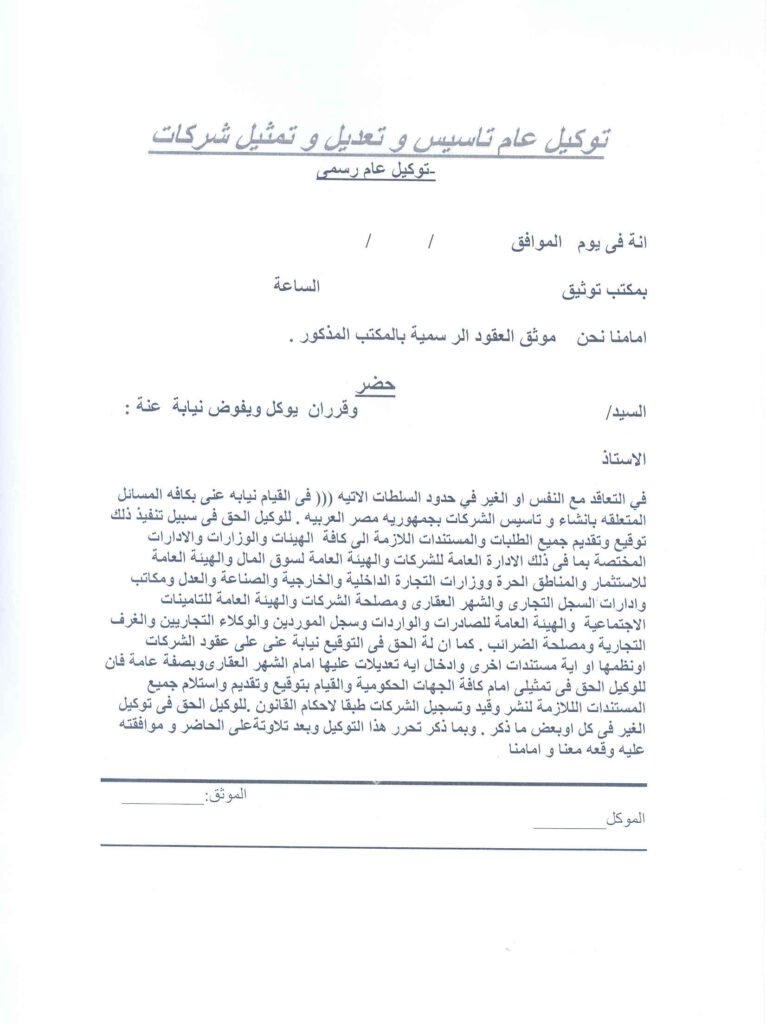
- The power of attorney should follow the content of the attached template (general power of attorney for incorporating, amending and representing companies).
- The founders’ names must match across the powers of attorney, their identification (national ID card, or passport for foreigners) and, for capital companies under Law No. 159 of 1981 or Law No. 72 of 2017, the bank certificate.
- The power of attorney should not be a special one, but a general power of attorney for incorporating, amending and representing companies.
- The agent’s full three-part name must match between the powers of attorney and the agent’s own ID.
- For powers of attorney executed outside Egypt:
- If executed before the Egyptian consul where the principal resides, it is accepted only after the consul’s signature is authenticated by the Egyptian Ministry of Foreign Affairs.
- If executed before the competent foreign authorities, it must be authenticated by the Egyptian consul in that country, and the consul’s signature then authenticated by the Egyptian Ministry of Foreign Affairs.
- The phrase “to contract with oneself or with others” should be added only where the founders’ agent is one of the founders or a partner in the company (in which case the power of attorney cannot be revoked except in the presence of both parties).
- Where a founder is a legal person (an Egyptian or foreign company) represented by its chairman (for joint stock companies) or its manager (for LLCs), there are two cases:
- If the representative is also a partner in the company being formed, the wording should read “on his own behalf and in his capacity as chairman of … company / manager of … company”.
- If they act only as the company’s representative, the wording should read “in his capacity” only.
- Where the legal person is an Egyptian company, the power of attorney must be accompanied by a document evidencing the representative’s capacity (for example, the commercial register extract), as well as a document evidencing the representative’s authority and the company’s approval.
How long does it take to form a company in Egypt?
There is no single timeframe for every company. It depends on the company type, whether the documents are complete, whether foreign investors are involved, the approvals required, any in-kind contributions, the activity and any comments raised during review.
The time needed to create the company should also be kept separate from the time needed to license the activity. The incorporation can be complete while the start of operations still depends on another approval or licence. Promising a fixed timeframe before reviewing the file may therefore be inaccurate.
Common mistakes in company formation in Egypt
Starting the procedures before reviewing the activity
Founders may discover after preparing the paperwork that the activity needs a special approval or a different legal form.
Choosing a company type on cost alone
The cheapest form at incorporation may create liability or restrictions that do not suit the project.
Adding a nominal partner
A partner listed in the documents acquires a legal position and ownership that no verbal understanding that they “own nothing” can erase.
Using a template contract without reviewing it
A template may be enough to complete the procedure, but it does not necessarily address management powers, partner exits or deadlock.
Giving the manager unchecked powers
Very wide powers can expose the company to unexpected acts, while excessive restrictions can paralyse day-to-day operations.
Leaving intellectual property unaddressed
Particularly in technology and creative businesses, it must be clear who owns the software, brand, content, database and other assets the project started with.
Ignoring the post-incorporation stage
A commercial register extract does not replace the licences, tax, social insurance and other registrations.
Confusing the company name with a trademark
A non-confusion certificate does not give the protection that a registered trademark does.
What should you receive once incorporation is complete?
The documents vary with the legal form and the scope of the engagement, but the client should know in advance what they will receive. The package may include the approved articles of incorporation or statutes, the incorporation documents, the commercial register extract, the tax card or registrations, the non-confusion certificate, chamber of commerce documents, copies of the powers of attorney and approvals used, proof of fee payment, and a statement of the steps still required before the business can operate.
Handing over documents is not enough without explaining whether the company is ready to operate or still needs another licence or registration.
Frequently asked questions about company formation in Egypt
What is the best company type in Egypt?
There is no absolute best type. The choice depends on the number of owners, the activity, liability, management, funding and plans for bringing in investors.
What is the difference between partnerships and capital companies?
Partnerships rest mainly on trust in the partners, and the general partner bears personal and joint liability. In capital companies the financial element dominates, and owners’ liability is in principle limited to the value of their contributions, with rules that differ from one form to another.
Is a sole proprietorship a company?
No. It is set up by a single natural person who trades through it as a merchant, and it is not based on a contract between partners or on capital divided into quotas or shares.
Can one person form a company in Egypt?
Yes. A single-person company can be formed under the legal conditions, and the sole proprietorship also exists, but the two differ in nature and consequences.
Can a foreigner form a company in Egypt?
Yes. Full foreign ownership is allowed in many activities, while some activities remain subject to restrictions, participation thresholds or special approvals.
Can a company be formed from outside Egypt?
In many cases, yes: the procedures can be handled through powers of attorney and documents that meet the notarisation and legalisation requirements. This depends on the legal form, the founders’ capacity and the procedures required.
Does the company need an office address?
The company must have a defined address and head office, and the procedures or licences may require documents proving the right to use the premises, depending on the case and the stage.
Does incorporation mean the activity is licensed?
No. Creating the entity is different from licensing the activity. Some activities need additional approvals or licences before operations can begin.
Are the procedures different in Cairo?
The same legal rules apply, but the authorities responsible for the premises, tax and licences may differ with the business location, and a significant part of the incorporation procedure can be completed online.
How much does it cost to form a company in Egypt?
The cost varies with the company type, capital, activity, partners, documents and licences. Government fees, expenses and professional fees should be kept separate.
Can the company be amended after incorporation?
Yes. Changes such as moving the head office, changing the activity, management or capital, or admitting and removing partners are possible, following the procedures and majorities required for each amendment.
Do the partners need a separate agreement?
A shareholders’ agreement may be necessary where the relationship needs broader rules on funding, management, exit, valuation of stakes, intellectual property and deadlock than the articles provide.
Does acceptance of the company name protect it as a trademark?
No. Acceptance of the name or a non-confusion certificate does not register it as a trademark. Protecting a name or logo as a trademark is a separate procedure.
Company formation services at LegalIn Law Firm
At LegalIn Law Firm, we do not treat company formation as a procedural task that starts with filing papers and ends with a commercial register extract.
The work starts with understanding the activity, the ownership structure and the management and funding plan, then identifying the legal form and procedures the project needs. Depending on each case and the scope of the engagement, our services include:
- Reviewing the project and choosing the right legal form.
- Identifying the legal framework governing the incorporation.
- Reviewing the activity and its related approvals and licences.
- Incorporating companies in all legal forms.
- Company formation for Egyptian and foreign investors.
- Registering branches of foreign companies and representative offices within their legal scope.
- Preparing and reviewing powers of attorney and founders’ documents.
- Reviewing foreign documents and their translation and legalisation requirements.
- Drafting articles of incorporation and statutes.
- Structuring the powers of managers, boards and signatories.
- Drafting shareholders’ agreements and pre-incorporation memoranda of understanding.
- Following up GAFI, commercial register and tax procedures within the scope of the engagement.
- Supporting the approvals and licences related to the activity.
- Registering the company’s trademarks and intellectual property.
- Company amendments, partner entries and exits, capital increases and changes of activity or management.
- Ongoing legal support after incorporation.
If you are planning to form a company in Egypt, the LegalIn corporate team can review your project details, the number and nationality of the partners, the activity, the capital and the management plan, and then set out the legal form, documents, procedures and expected cost before any step is taken.
Laws referenced (Arabic texts)
- Investment Law No. 72 of 2017, as amended
- Companies Law No. 159 of 1981, as amended
- Law No. 4 of 2018 amending the Companies Law
This guide provides general legal information based on the rules and sources available at the date of review. It does not replace advice on the facts and documents of a specific case.